
Why California Is Transitioning From HERS to ECC (And What It Means for Your Project)
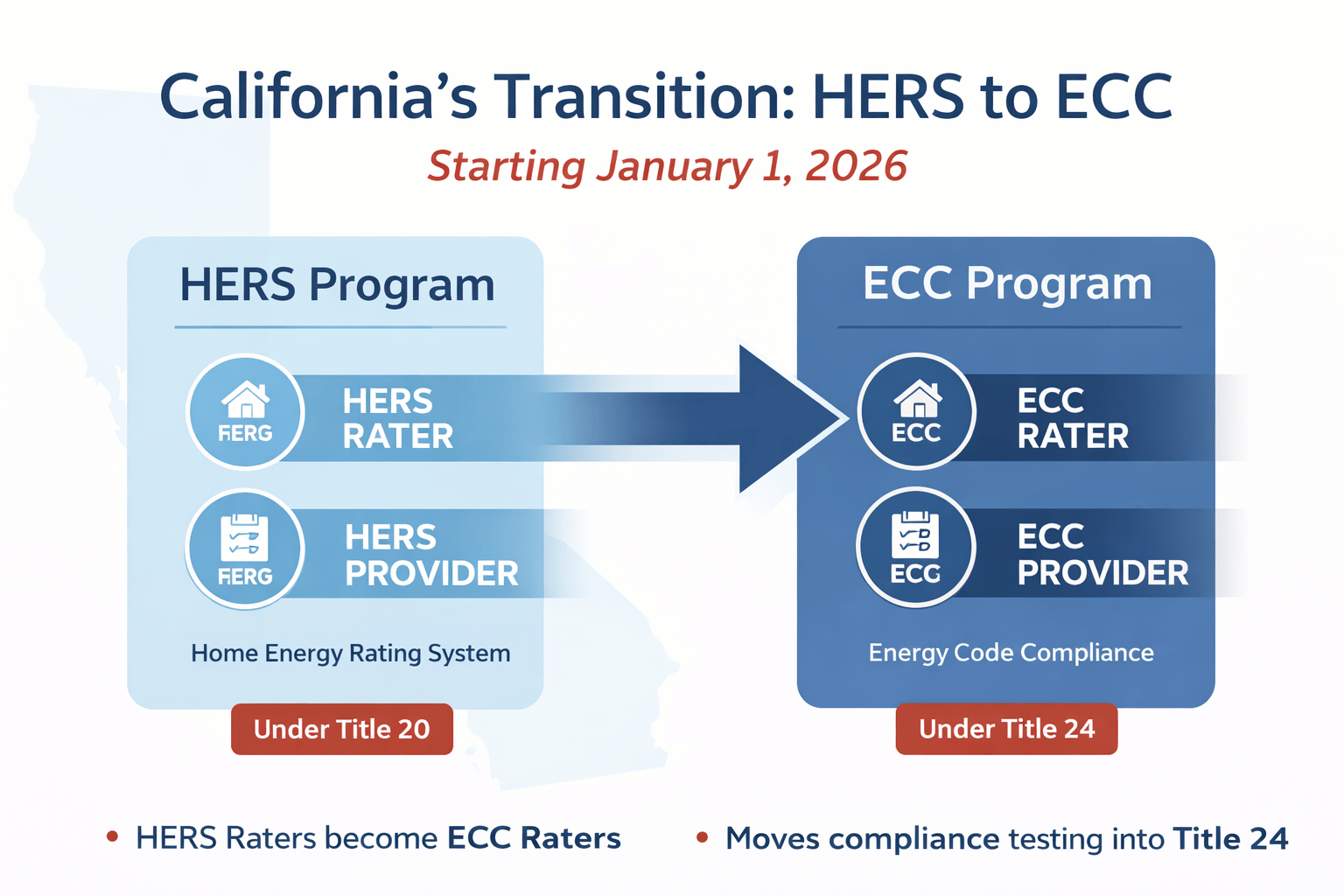
If you’ve worked in California HVAC or residential construction, you’ve likely heard the term HERS testing for years. Beginning January 1, 2026, that familiar language is changing. California is officially transitioning from the HERS Program to the Energy Code Compliance (ECC) Program under Title 24.
While this change may sound significant, it’s important to understand what’s actually changing, why it’s happening, and what stays the same.
What Was the HERS Program?
HERS, short for Home Energy Rating System, was California’s long-standing framework for Field Verification and Diagnostic Testing (FV&DT). Certified HERS raters performed required testing—such as duct leakage, airflow, refrigerant charge, and quality installation verification—to confirm that installed HVAC systems met the project’s approved energy compliance documents.
HERS raters and providers were regulated primarily under Title 20, while the energy standards themselves lived under Title 24, which often created confusion about roles, documentation, and enforcement.
What Is ECC?
ECC stands for Energy Code Compliance. The ECC Program replaces the HERS Program as part of California’s 2025 Energy Code cycle, effective January 1, 2026.
Under ECC:
- HERS Raters become ECC Raters
- HERS Providers become ECC Providers
- Field verification testing is now formally governed under Title 24, aligning it directly with California’s building energy code
This is primarily a structural and regulatory alignment, not a reinvention of testing requirements.
What Is Actually Changing?
Here’s what contractors and homeowners should know:
1. Terminology & Documentation
Projects permitted under the 2025 Energy Code will reference ECC instead of HERS on forms, certificates, and compliance documents.
2. Program Oversight
The ECC framework brings compliance testing fully under Title 24, improving consistency, clarity, and enforcement across the state.
3. Training & Certification
Existing HERS raters carry forward as ECC raters, but updated ECC training and certification through an approved provider will be required for work on 2025-code projects.
4. Registries & Reporting
Testing results must be submitted through approved ECC registries (such as CHEERS), which now operate under ECC rules.
What’s NOT Changing
The actual field tests—duct leakage, airflow, refrigerant charge verification, quality installation checks—remain largely the same. The work itself is familiar; the structure around it is what’s evolving.
Why Is California Making This Change?
The transition from HERS to ECC is about clarity and alignment, not added burden.
Key reasons include:
- Placing compliance testing directly under Title 24, where energy standards already live
- Improving oversight and accountability
- Reducing confusion around responsibilities, documentation, and enforcement
- Creating a more streamlined, modern compliance framework
For contractors, this ultimately supports cleaner closeouts and fewer surprises during final inspection stages.
What This Means for Contractors
- Projects permitted before January 1, 2026 follow the HERS framework
- Projects permitted on or after January 1, 2026 fall under ECC
- Contractors should ensure their testing partners are ECC-certified and registry-ready
- Documentation language will change, but required testing will feel familiar
Working with an experienced ECC rater helps ensure compliance steps are handled correctly, on time, and without unnecessary delays.
What This Means for Homeowners
From a homeowner’s perspective, the transition is mostly behind the scenes. Testing is still required to verify HVAC installations meet California energy standards, and the inspection process remains professional and straightforward.
The ECC transition helps ensure energy compliance is handled consistently and correctly—protecting both safety and long-term system performance.
How Compliance Matters Fits In
Compliance Matters is a certified ECC testing and compliance partner, supporting Title 24 inspections, permit coordination, duct cleaning, and dryer vent cleaning for residential and new construction projects.
Based in Stockton, CA, we support contractors and homeowners throughout Northern California, providing:
- ECC Title 24 testing
- Permit coordination
- Real-time job visibility through our contractor workflow
- Clear documentation and smooth project closeout
Our focus is simple: reduce friction, remove guesswork, and help projects move forward correctly.
Need Help Navigating the ECC Transition?
If you’re a contractor preparing for the 2025 Energy Code—or a homeowner with an upcoming project—Compliance Matters can help guide the process clearly and efficiently.
📞 Call or Text: 209-518-2383
📧 Email: eddie@compliancemattersca.com